
Rebranding This Substack
Blogging is Dead. Long Live Blogging.

You might notice this site looks a bit different lately.
For the past two years, I’ve been unsure what to do with substack.
It started when I made one just to follow a few authors I like, and I toyed with the idea of writing my own—but didn’t commit to it.
Everything changed in the summer of 2023 when I went viral on Twitter for an experiment I did regarding AI in the classroom, back when I was an adjunct instructor at Elon University.
Due to the burst of interest in my writing on religion and technology, I decided to start my own website and host my writing there—which I’ve done for two years at www.cwhowell.com.

Why I Chose Ghost First
I ran my own website rather than substack for two reasons:
The superior customization. I wanted it to look different than other newsletters.
Search Engine Optimization.
Number two was of paramount importance. Ever since it launched, my site has had inordinately strong SEO—mostly due to the website it’s hosted on, ghost.org (which I highly recommend if you ever need to start your own site for whatever reason).
Despite my small number of subscribers, articles I wrote on a few niche topics like The Book of the New Sun or David Bentley Hart’s novel Kenogaia ranked near the top of Google’s search results if you tried to look up those books.
However, despite some traction in reviewing books. The site has struggled in the past year to get the same attention it did the first year. Largely, this is because of Google’s changes to the way Search works, and a prioritization of AI at the expense of seemingly everything—even a workable product.
We’ve all seen how spectacularly awful Google’s AI answers can be. From recommending that people eat rocks for health reasons to gluing cheese to your pizza, it’s clear that the product was maybe not fully ready for primetime. The fact it’s gotten better since then hasn’t diminished the central problem of its confabulation of false information.
But what it has done (aside from purveying nonsense and eroding our shared sense of reality) is dramatically blunt the efficacy of SEO, at least for personal sites.
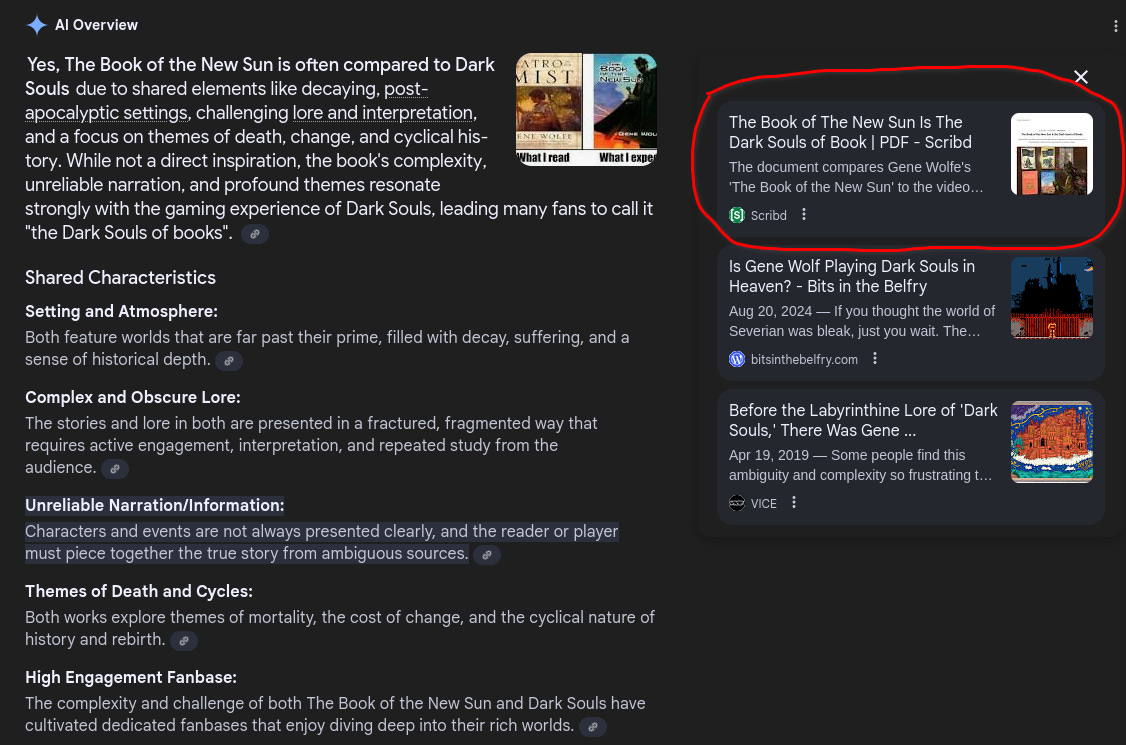
My most popular essay is about The Book of the New Sun and Dark Souls. If you searched for The Book of the New Sun it would show up relatively high (even hitting the front page in the image search). But now, if you search for links between The Book of the New Sun and Dark Souls (or even just religion, for that matter), you get a smorgasbord of AI generated answers ripped from a dozen different sources. And my contributions are either not cited or squirreled away in a footnote that no one will click on.
The upshot is that it’s now much harder for anyone to find my writing through Google. Search traffic has stagnated as a result.
Going Back to Substack
So that brings me back to this website. I hadn’t wanted to use substack because it is a closed ecosystem and it’s difficult to find substack pages through ordinary search engines.
But now that it’s difficult to find any websites through ordinary search engines, what I had thought was substack’s weakness might be its strength.
In increasingly “enshittified” internet (and, frankly, reality), a closed ecosystem of users interacting with each other and prioritizing the written word may be the right place to turn. It’s a bulwark where human writing (might) still matter. At least somewhat.
I had been using this site only occasionally to link the writing I did on my own site. But now, these roles will have to reverse.
On the Name “Publish and Perish”

When I was an undergrad at UC Riverside, I briefly attended a class on Existentialism. Because the professor thought the best way to teach this course would be to have freshmen read the entirety of Being and Nothingness, I dropped it faster than a hot potato.
But something he said in that introductory meeting always stuck with me. Someone asked about his background and he said, “You know the saying ‘publish or perish?’ Well, I perished.”
This might have been the first time I had actually heard that phrase. And perhaps fifteen years ago, that was still how it worked. The way he explained it, it was a simple binary. You do one or the other.
No longer. Now you do both. Or, at least, that’s what I did. With the academic job market in a tailspin, with higher education under assault from our own government, and with AI upending a humanities educational system that was already on life-support, there’s simply nowhere to go.
But beyond academic work, there is a more global version.
As an unabashed techno-pessimist, my hope for the future vanishes by the day. But as surveillance capitalism has gone from a terrifying prospect to a monotonous reality, there is more need than ever to band together and rage against the dying of the light.
It might be little more than rearranging deck chairs on the titanic, but at least we get to go out swinging. So, in one respect at least, I’ll be content to publish and perish.
So if writing on religion, technology, and science interests you—writing that I hope is clear and accessible without being laden with jargon and obfuscating prose—then I hope you might stick around too.